Chandra Grahan 2026: Lunar Eclipse Date, Time, India Visibility & Dos Don’ts
Wed - Feb 18, 2026
3 min read
The first complete lunar eclipse of 2026 will occur on March 3, which is commonly referred to as Chandra Grahan in India. The solar eclipse in February will be followed by the following astronomical event, which will be visible in many regions of the planet.
Table of Contents
- Lunar Eclipse 2026 Overview
- Date and Time of Chandra Grahan 2026
- Is the 2026 Lunar Eclipse Visible From India?
- Visibility in Worldwide
- Dos and Don’ts During Lunar Eclipse 2026
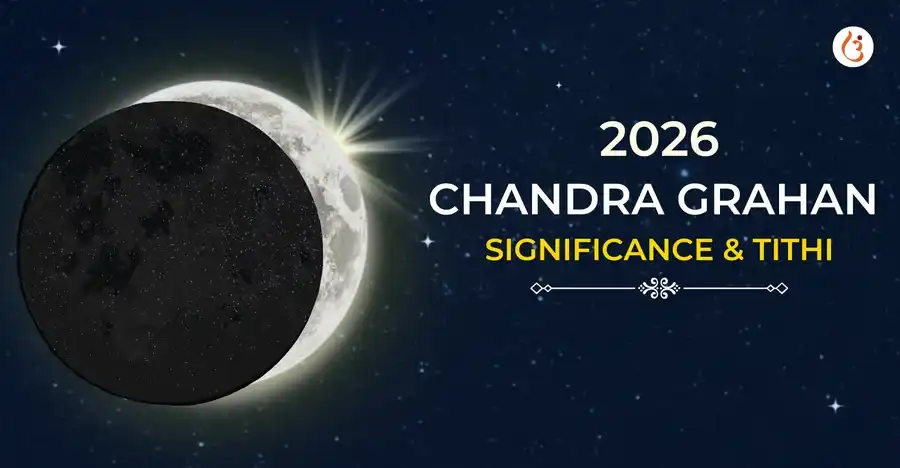
Lunar Eclipse 2026 Overview
When Earth passes directly between the Sun and the Moon, it creates a massive shadow that turns the Moon a deep reddish-orange color. This phenomenon is known as a lunar eclipse. According to NASA, this alignment is only possible during a full Moon phase. There are two forms of Lunar Eclipse (Chandra Grahan) - complete and partial. When the Moon is entirely obscured by the Earth's umbra, or darkest shadow, a total lunar eclipse (Chandra Grahan) takes place, giving the Moon a crimson appearance. For this reason, this phenomenon is also known as "Blood Moon."On the other hand, only a segment of the Moon enters the Earth's shadow during a partial lunar eclipse (Chandra Grahan).
Date and Time of Chandra Grahan 2026
On Tuesday, March 3, 2026, there will be the first complete lunar eclipse of the year. The second lunar eclipse of the year will take place on August 28, 2026, as a partial lunar eclipse.
Lunar Eclipse Time in 2026
According to UTC, the eclipse's partial phase begins at 09:50 and its penumbral phase begins at 08:44. While the peak eclipse happens at 11:34 and the full event ends at 15:38, the total eclipse begins at 11:04 and ends at 12:02. The eclipse will be seen in India around 6:26 PM at moonrise according to Indian Standard Time. Between 6:33 and 6:40 PM, the greatest visible phase will take place; it ends at 6:46 PM.
Is the 2026 Lunar Eclipse Visible From India?
Indeed. Since totality happens earlier, India will only be able to see a portion of the lunar eclipse, primarily during the latter stages at moonrise.
Visibility in Worldwide
Depending on visibility at night, the eclipse will be visible over the Pacific, Atlantic, and Indian Oceans, as well as the Arctic and Antarctic areas, as well as Eastern Europe, Asia, Australia, North and South America. Lunar Eclipse 2026: Who Can See? The middle Pacific, northwest North America, and northeast Asia will offer the greatest views. While watchers in the Americas will experience the eclipse around the moonset, those in India and Australia will see it at moonrise.
Dos and Don’ts During Lunar Eclipse 2026
Do: Use binoculars or the unaided eye to observe; no filters are required. The observant must follow Sutak times while they observe ancient customs.
Don’t:
Eclipses (Grahan) are considered to be spiritually sensitive periods in many civilizations, especially in India. Food and Drink: Many people think that food turns "impure" during the eclipse, thus they avoid cooking or eating .To "protect" food containers, traditional households may put Darbha grass or Tulsi leaves inside. Personal Rituals: To purify oneself, it is customary to take a ceremonial bath both before and after the eclipse.
Spiritual Practice: Many utilize this time for meditation and chanting mantras to gather good energy.
For Pregnant women : Medical professionals claim there is no scientific harm to the unborn child, but traditional counsel frequently advises pregnant women to stay inside and refrain from handling sharp things like knives.